Thursday, May 30, 2013

Once a "Knucklehead," Always a "Knucklehead"

For years, students have been driving teachers up a wall. But not all of them. There’s always the select group of students that misbehaves on a regular basis.

The Columbine incident is one of the most, if not the most,
infamous of school shootings. It was performed by two students.
Source: columbine-online.com
According to the Huffington Post, since the Columbine incident in 1999, schools have been stepping up their games as they add police officers to the staff, creating something known as the “school-to-prison pipeline.” In many other schools, like in Denver, Colorado, these police officers arrest students and put some into juvenile detention centers or prison. “For some kids, that’s the entry point, their chances of getting involved with the criminal justice system again just skyrocket once that first arrest has been made,” civil rights attorney Browne Dianis told the Huffington Post.

Sterling High School has its own prison, which is most commonly known as Internal suspension. Mr. O’Donnell, the Internal suspension monitor, says that he may see up to “ten people on any given day,” the average being between three and four. O’Donnell also states that there are “numerous repeat offenders,” saying that he may see a student at least once a week. Instead of being arrested for murder and bank robbery, students are sent to Internal mainly because they don’t follow directions, talk back to teachers, or violate the dress code.

But the misbehaving doesn’t stop in schools. Outside of school, prisons are filled with people who misbehave, and we all have to pay for it through taxes. We spend so much time taking down the “knuckleheads” and locking them up, away from the rest of us.

This time and energy is spent on a whopping 4% of the population. In 2011, there were 7,139,104 arrests in cities around the country, but that barely makes a dent in a total population of 163,760,401 people.

Despite the percentage of “knuckleheads” being this low, it seems like there are more and more of them every day. The news is full of “Who killed whom?” and “Someone just got assaulted!”
If you look at the news, you’d think the “knuckleheads” were multiplying, but they’re not. The numbers are actually going down. According to an FBI crime report, “The number of persons arrested in 2011 decreased 4.6 percent when compared with the number of persons arrested in 2010.”

The Bureau of Justice shows that this 4% of the population is full of repeat offenders. It says that “Of the 272,111 persons released from prisons in 15 states in 1994, an estimated 67.5% were rearrested for a felony or serious misdemeanor within 3 years, 46.9% were reconvicted, and 25.4% resentenced to prison for a new crime.”

“I have encountered hundreds of inmates that are repeat offenders. I have met different generations in prison from father and sons, even grandfathers, fathers and sons all incarcerated,” says Corrections Officer Cesar Garcia. “I believe that most inmates re-offend because the lack of structure in their life, and environment plays a huge part.”

Garcia states that many inmates who are released don’t have anywhere to go and live in high-violence areas like Camden, Newark, and Trenton. Camden was proclaimed the most dangerous city in the nation in 2003, 2004, 2008, and 2009, and it is often found in the top ten. This year, it’s ranked number two on this infamous list.

From schools to prisons, “knuckleheads” continue to drive the rest of us up a wall, and it’s the same people over and over again. Once you’re in the justice system, it can be a very vicious cycle with no escape.

Tuesday, May 7, 2013

“CISPA? What’s that?”


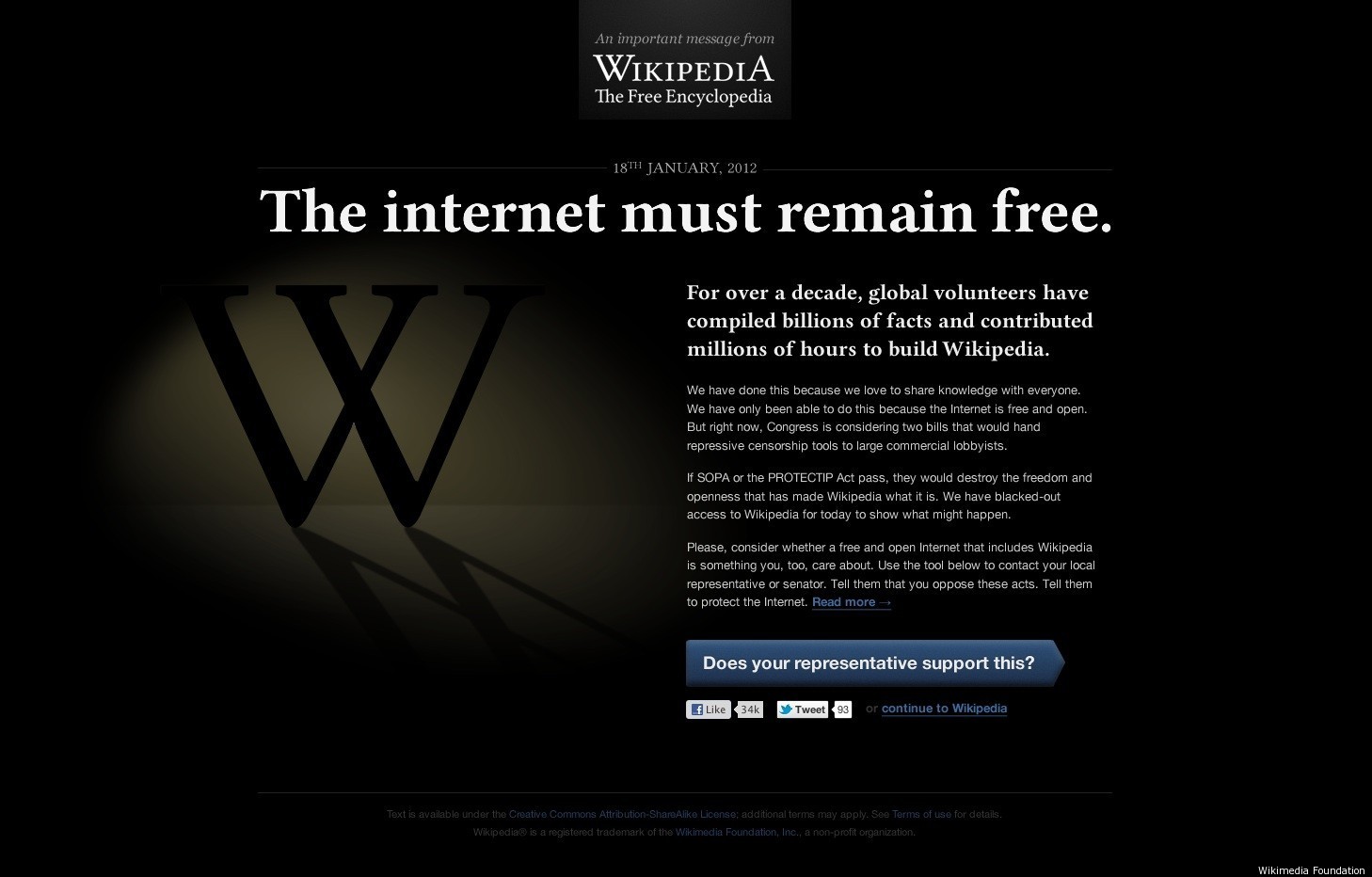
Back in January of 2012, the hacker group Anonymous called for an internet blackout to protest the Stop Online Piracy Act and Protect IP Act. An internet blackout is when websites either show support or block usage and spread awareness.

Google's "blackout" homepage on January 18th, 2012.
(Credit: Jonathan Skillings/CNET)

On January 18th, 2012, Google honored the blackout by placing a black bar over the word “Google” on its homepage. Wikipedia shut down its services altogether, providing only a message in white text to spread awareness over a darkened background.

All sites that participated in the blackout provided links for uninformed consumers to contact their government representatives. Some consumers didn't even log onto the internet, treating it like an internet boycott.

On April 22nd, 2013, Anonymous had called for another internet blackout to protest the Cyber Intelligence Sharing and Protection Act, an act that would allow internet websites to share someone’s information without his permission. Unlike the last blackout, companies like Google and Wikipedia didn’t participate.


The younger generations should be aware of the CISPA, but there’s a chance that they have no idea that this is happening. The news about these internet bills rarely reaches television, and the battle is entirely online.

Twitter is one of the few places where the CISPA protests exploded with the hashtag #CISPABlackout, and thousands of informed internet users signed petitions and blacked out their websites or blogs.

An informal survey taken at Sterling High School reveals just how much students know about the CISPA and Anonymous.

Of the thirteen students interviewed, only three heard of the CISPA. Two actually knew what it was, though more students were aware of last year’s SOPA/PIPA blackout.

The collective hacker group Anonymous called
for another internet blackout to protest the CISPA.
(Credit: twitter.com)
When asked about the hacker group Anonymous, a majority of students either didn’t have an opinion or had no idea what it was. Russel Conrad, a more informed student, had this to say about Anonymous: “They do good.”

The uninformed students were told what the CISPA was and asked their opinions on the matter. A majority of students said that it’s a “violation of privacy” or say they just “don’t like it.” Natasha Wolfhope calls it a “violation of Constitutional rights” and that it “violates privacy.”

“It’s not fair,” says Ashley Morris, a senior who rarely uses the internet.

Jasmine Campi calls the CISPA  “Pure evil,” but not all students reacted negatively to the CISPA. Kellyn Lowden says “Well, I’m putting it out there. It’s there for people to take, I guess.”

Nearly all students use the internet in their daily lives, and most of them use Facebook, which explains why they may not have heard of it since the blackout took place on Twitter and parts of Tumblr.

Many students are still uninformed, and it’s possible that this could happen again. The generation that lives in the internet has a right to know when these types of bills are up for vote.